
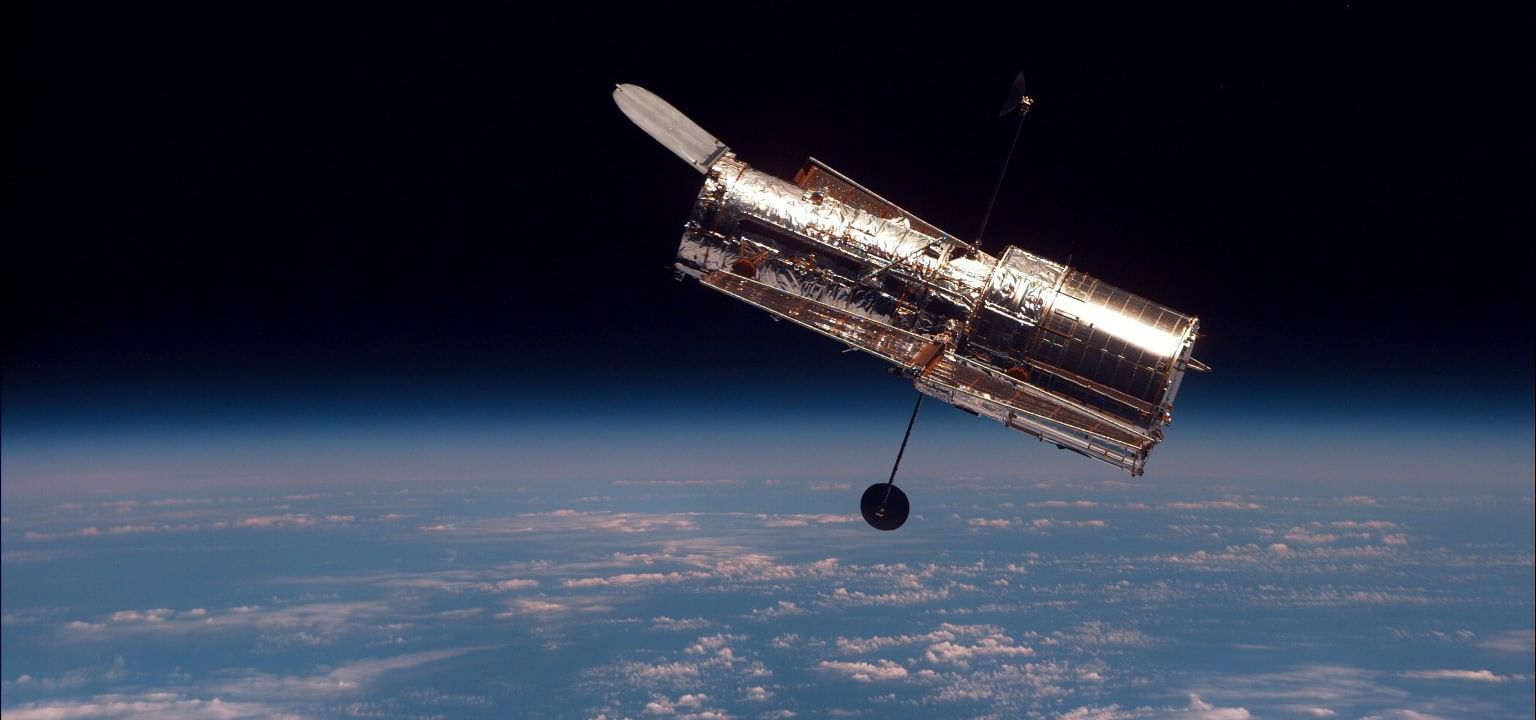
The Hubble Space Telescope, captured during a servicing mission in February 1997. Credit: NASA
The Hubble Space Telescope, captured during a servicing mission in February 1997. Credit: NASA
The Hubble Space Telescope, captured during a servicing mission in February 1997. Credit: NASA
Let's start with the basics. What is a space telescope, and how does this technology fit into the larger pursuits of space exploration?
A space telescope is an observatory that operates in outer space. Above Earth’s atmosphere, astronomers and astrophysicists can get a clear view of the universe in particular wavelengths—like ultraviolet and infrared light—that enable studies of celestial objects and phenomena that they otherwise could not see due to the atmosphere’s interference.

Shuttle STS-61 Onboard View of the Hubble Space Telescope, 1993.
Shuttle STS-61 Onboard View of the Hubble Space Telescope, 1993.
Shuttle STS-61 Onboard View of the Hubble Space Telescope, 1993.
Your Living Room talk on December 1st explores the origins of the Institute, a story many Baltimoreans and Blue Jays may not know. How did STScI come to be established on JHU’s campus, and what is the connection to the University?
 Fifty years ago, a distinguished panel of scientists met to discuss the future of astronomy. In the 1970s, NASA had begun designing the first “space telescope”—later renamed after astronomer Edwin Hubble. The panel summarized its conclusions and recommendations in a report to the National Academy of Sciences.
They called for the establishment of a Space Telescope Science Institute (STScI) to serve as the interface between large space observatories and the scientific user community. Their vision became reality in 1981 when STScI was established on the Homewood Campus of Johns Hopkins. STScI is managed by the Association of Universities for Research in Astronomy (AURA)—a nonprofit entity operating under contracts with the National Science Foundation and NASA.
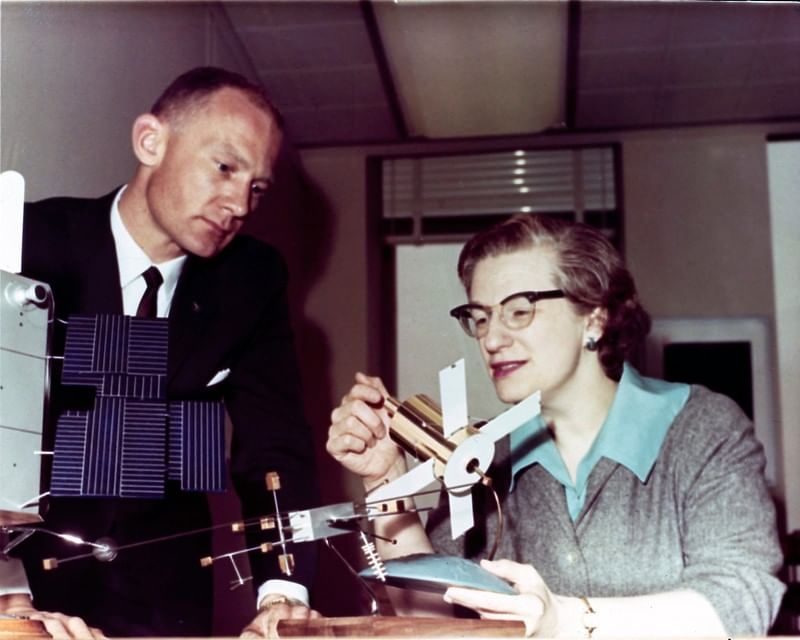
Pictured: Dr. Nancy Grace Roman, NASA's first Chief of Astronomy and "the mother of Hubble," explains the Advanced Orbiting Solar Observatory (AOSO) to Astronaut Edwin "Buzz" Aldrin in 1965 in Washington, D.C. Credit: NASA
How would you describe the STScI community? What makes this initiative an asset to both the campus and the city of Baltimore?
STScI is a visionary, world-class community of astronomers, data scientists, engineers, communicators, and educators—all working to advance humanity’s exploration of the universe, and to share our data and discoveries freely with the public. STScI is also home to the Mikulski Archive for Space Telescopes (MAST), which provides open-access archival data from more than 20 astronomical missions.
No other college campus or city can say they host the institute that operates humanity’s most powerful eyes on the universe! In addition to providing jobs for about 800 Baltimoreans, STScI also offers internships and fellowships for students, and works closely together with JHU’s Department of Physics and Astronomy.
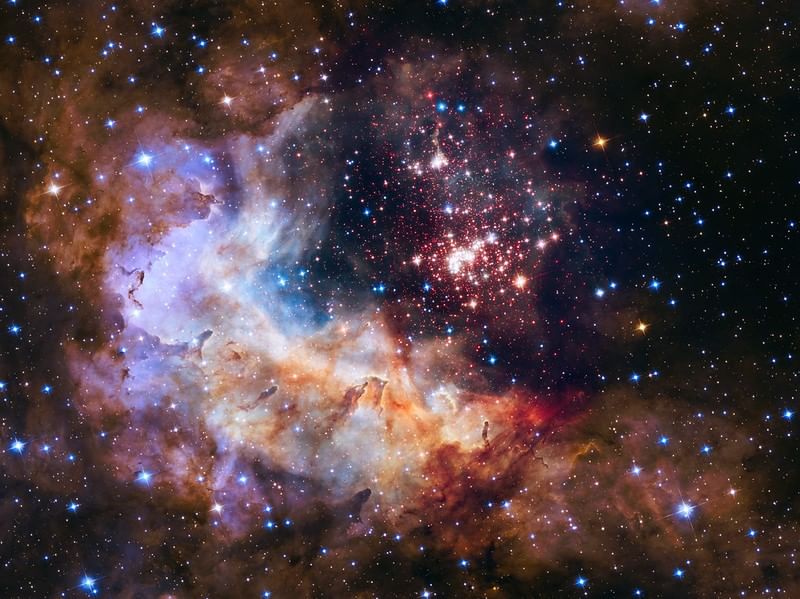
Westerlund 2, a giant cluster of 3,000 stars between 6 to 13 light-years across. Credit: NASA, ESA, A. Nota (ESA/STScI), and the Westerlund 2 Science Team
Westerlund 2, a giant cluster of 3,000 stars between 6 to 13 light-years across. Credit: NASA, ESA, A. Nota (ESA/STScI), and the Westerlund 2 Science Team
Westerlund 2, a giant cluster of 3,000 stars between 6 to 13 light-years across. Credit: NASA, ESA, A. Nota (ESA/STScI), and the Westerlund 2 Science Team
Your work focuses on science communication, leading a team that focuses on translating scientific research and discoveries into stories and information that people can understand and connect with. Tell us what that work looks like in practice, and what brought you to the Institute.
I’ve been working as a science communicator, strategist, and leader within NASA’s and NOAA’s Earth system and climate science communities for about 30 years. My transition to STScI in May 2026 was an exciting new opportunity for me to learn more about space science, and to share the awe and excitement of exploring the universe with the public.
I lead STScI’s Office of Public Outreach (OPO). My team communicates in a variety of ways about NASA’s space telescopes and the observations and new knowledge they’re producing. Through written and oral storytelling, data visualizations, scientific illustrations, public presentations and dialogs, tutorials and training workshops, and student internships and fellowships—our job is to actively engage the public and let them in on the fun and excitement of exploring the universe.
Specifically, we highlight fascinating new scientific discoveries via news releases published on NASA’s website, mainstream news media, and social media. We make the unseen seen by producing stunning images and videos of celestial objects and phenomena that the telescopes are designed to see in wavelengths that our eyes cannot see. We contextualize and interpret these observations and new research findings via science explainers, videos, and interactive tools to help the lay public understand and use this information.
For those who may not know much about astronomy, where do you suggest they start? What are some of the things happening in the field that might spark our curiosity or change the way we look at the universe?
Anyone new to astronomy should start their exploration on our Universe of Learning website—it offers free videos, articles and explainers, interactive tools, and educational resources to help people understand how we use space telescopes to unlock the secrets of the universe.
For example, what are dark energy and dark matter? Together, they make up about 95% of the universe. They’re what holds the fabric of the universe together while driving it to expand. We know they exist and yet we don’t know what they are! It’s an exciting mystery that we’re working on now using NASA’s newest mission: the Nancy Grace Roman Space Telescope.
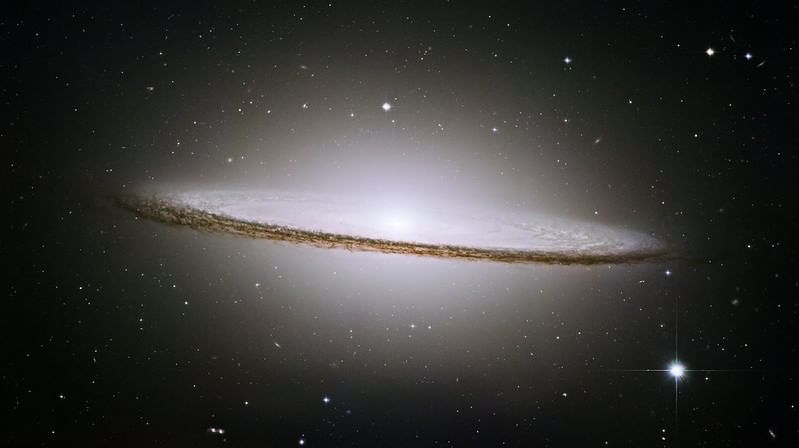
The Sombrero Galaxy, galaxy M104, captured by Hubble. Credit: NASA and The Hubble Heritage Team (STScI/AURA)
The Sombrero Galaxy, galaxy M104, captured by Hubble. Credit: NASA and The Hubble Heritage Team (STScI/AURA)
The Sombrero Galaxy, galaxy M104, captured by Hubble. Credit: NASA and The Hubble Heritage Team (STScI/AURA)
What advice would you offer to Hopkins students or others interested in a career in science communication?
I think science is humanity’s best system and strongest evidence basis for advancing our understanding of reality. So, my advice is to stay curious, ask lots of questions, and enroll in science courses. Learning more about the world and universe is a fun and rewarding way to feed the inner child inside all of us who approach nature with a sense of awe and wonder. And sharing what you learn with others is a great way to inspire and enrich the lives of others.
Enroll in courses that can help you improve your skills as a science communicator. There are many fascinating career pathways you can take in this field—from public science policy to science education, to writing and editing, data visualization, graphic arts and scientific illustration, videography, web and interface design, and software engineering—the list goes on.... Personally, I’m interested in “the science of science communication”—the theory and evidence basis for how to effectively communicate about science.
How can people stay connected to the Institute and follow its work?
Please visit us online at www.stsci.edu, or subscribe to our free electronic newsletter: STScI Events
You can also get news and updates about our work on our social media platforms, including: YouTube, Facebook, Instagram, LinkedIn, and X. There's a whole universe of things to talk about!